
How Verbis brings together streaming speech translation, linguistic intelligence, and Salesforce workflows.
Imagine calling customer support in your own language and speaking naturally with an agent who speaks a completely different language. You ask a question, the agent understands, and you hear the response in your language – without an interpreter or awkward pauses between every sentence.
Real-time voice translation promises exactly that. Yet enterprise customers need more than fast speech. They need accurate product terminology, correct pronunciation, business context, and reliable records of what was said.
The real challenge is combining conversational speed with enterprise-grade linguistic control.
Two approaches, each solving part of the problem
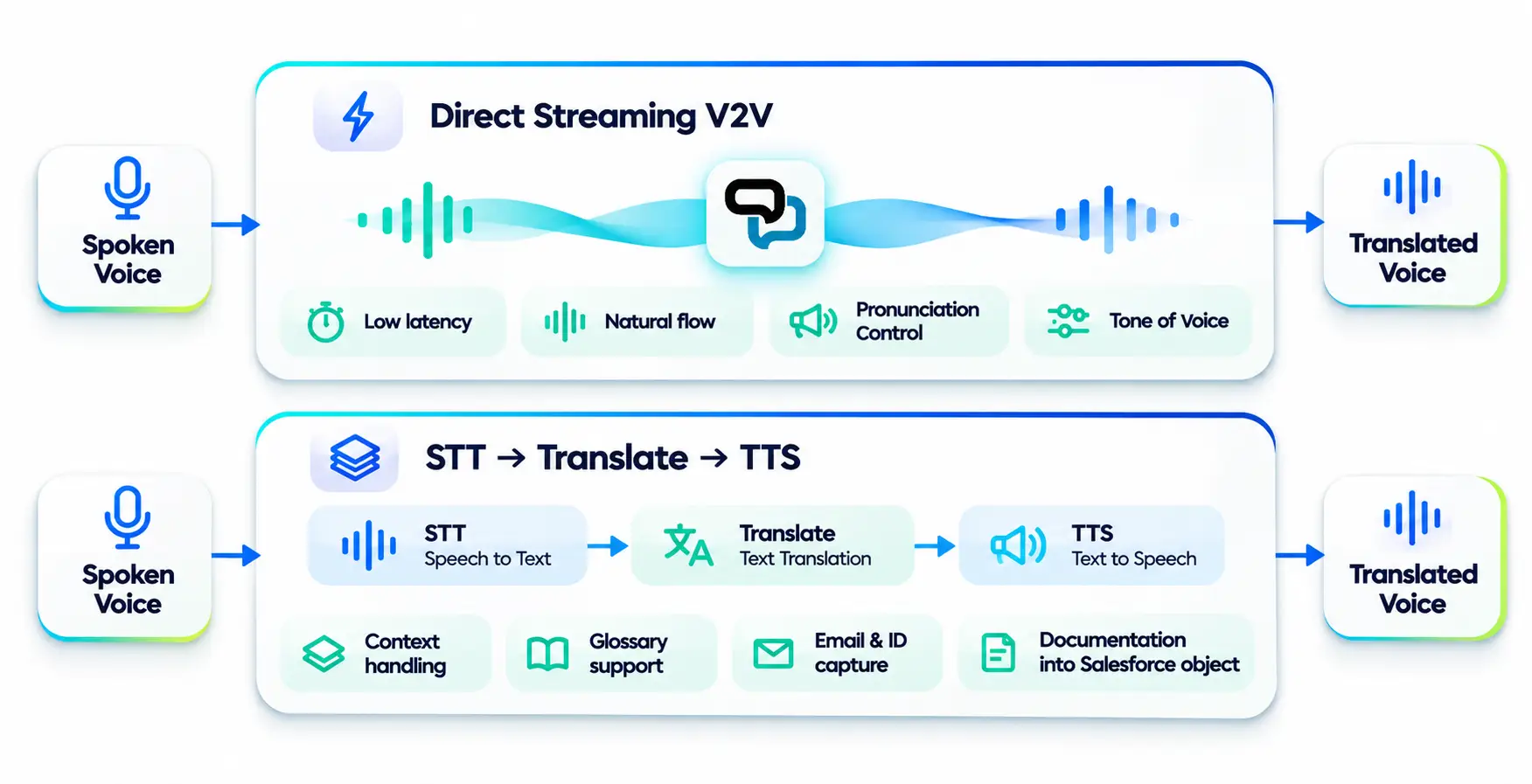
Direct streaming voice-to-voice translates incoming speech into spoken output with minimal delay. It can begin delivering translated audio while the speaker is still talking. The result can feel more conversational, but terminology and pronunciation controls depend on the model.
Streaming speech-to-text (STT) → translation (MT) → text-to-speech (TTS) provides visible intermediate text and more opportunities for glossary control, specialized engines, structured data capture, and documentation. The trade-off is typically additional processing complexity and delay.
Verbis: combining speed with linguistic intelligence
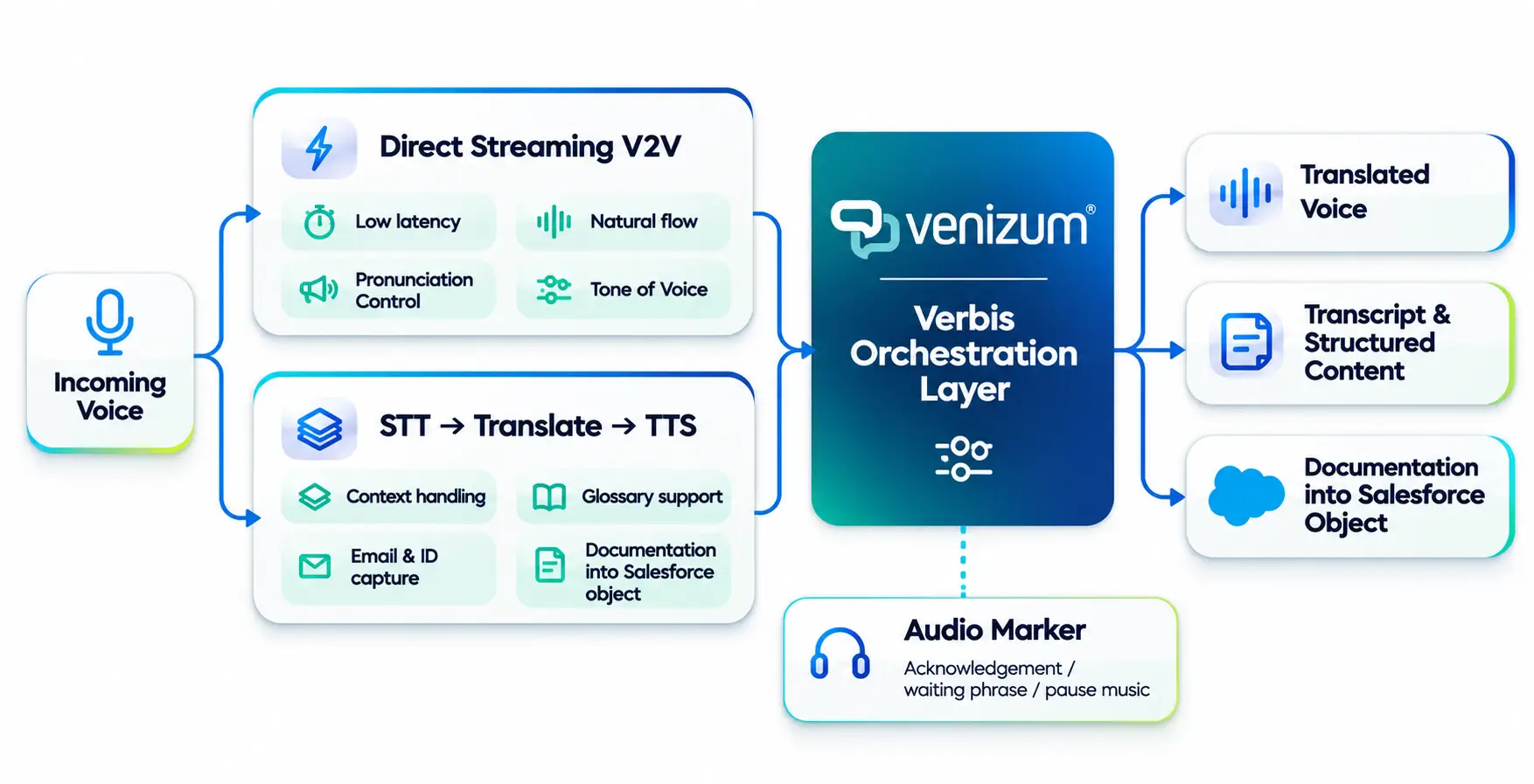
Verbis brings the two approaches together as complementary processing paths. The direct streaming voice path focuses on a natural, low-latency conversation. In parallel, text-based linguistic processing provides context, terminology, and pronunciation capabilities, while handling structured information and documentation within Salesforce.
The value isn’t simply running two models at once; it is orchestrating how conversation, linguistic quality, and business-process information work together. Where a direct audio model supports control interfaces, context and terminology can guide speech generation. The text path also supports checking and recording important information separately from the live audio.
Verbis parallel voice intelligence
Why pronunciation, context and structured data matter
In manufacturing, healthcare, or financial services, a sentence can sound natural yet still mishandle a product name, medical term, or customer reference. Verbis supports context handling, pronunciation, and tone controls within its supported translation and voice workflows, including DeepL capabilities.
Consider a caller giving an email address and identification number. The agent needs to understand the conversation immediately, but the organization also needs those values captured correctly. The STT-based Verbis flow handles email addresses, ID numbers, and documentation into Salesforce, complementing the real-time translated conversation.
A better way to evaluate latency
A common comparison looks at how long an engine takes to generate translated audio. For customer service, that is only part of the story. Streaming translation can start before a speaker finishes: end-of-turn latency can therefore be negative.
Another important metric is end-to-end conversation latency: the time from when a customer finishes speaking until the customer hears the first translated word of the agent response, excluding the agent’s thinking and reaction time. This measures the technical delay across both directions of the conversation rather than one model in isolation.
Verbis also supports audio markers – brief waiting acknowledgments, untranslated phrases, or pause music that can play during this interval. They do not eliminate technical translation delay, but they can reduce the perception of unexpected silence and keep the interaction feeling continuous.
Built around the Salesforce conversation
A multilingual customer interaction is not just an exchange of audio. It can create case notes, customer details, follow-up actions, and service documentation. By combining direct voice translation with structured linguistic processing, Verbis connects the spoken interaction to the Salesforce workflow.
For enterprise teams, the potential outcome is a more natural conversation, greater consistency in terminology and pronunciation, and more useful information captured during the interaction – without treating translation as a disconnected application.
The future is parallel linguistic intelligence.
Direct voice translation will continue improving in speed and naturalness. Enterprise language processing will continue providing valuable control over terminology, context, and business records. Verbis is bringing these strengths together rather than treating them as competing alternatives.
The future of multilingual customer service is not only speaking another language faster. It is understanding customers, communicating naturally and turning conversations into business value.